Financial statements aren't maths. They're a story.
Part 1 of my Stanford finance series for non-finance leaders — starting with the thing that unlocked all the rest.
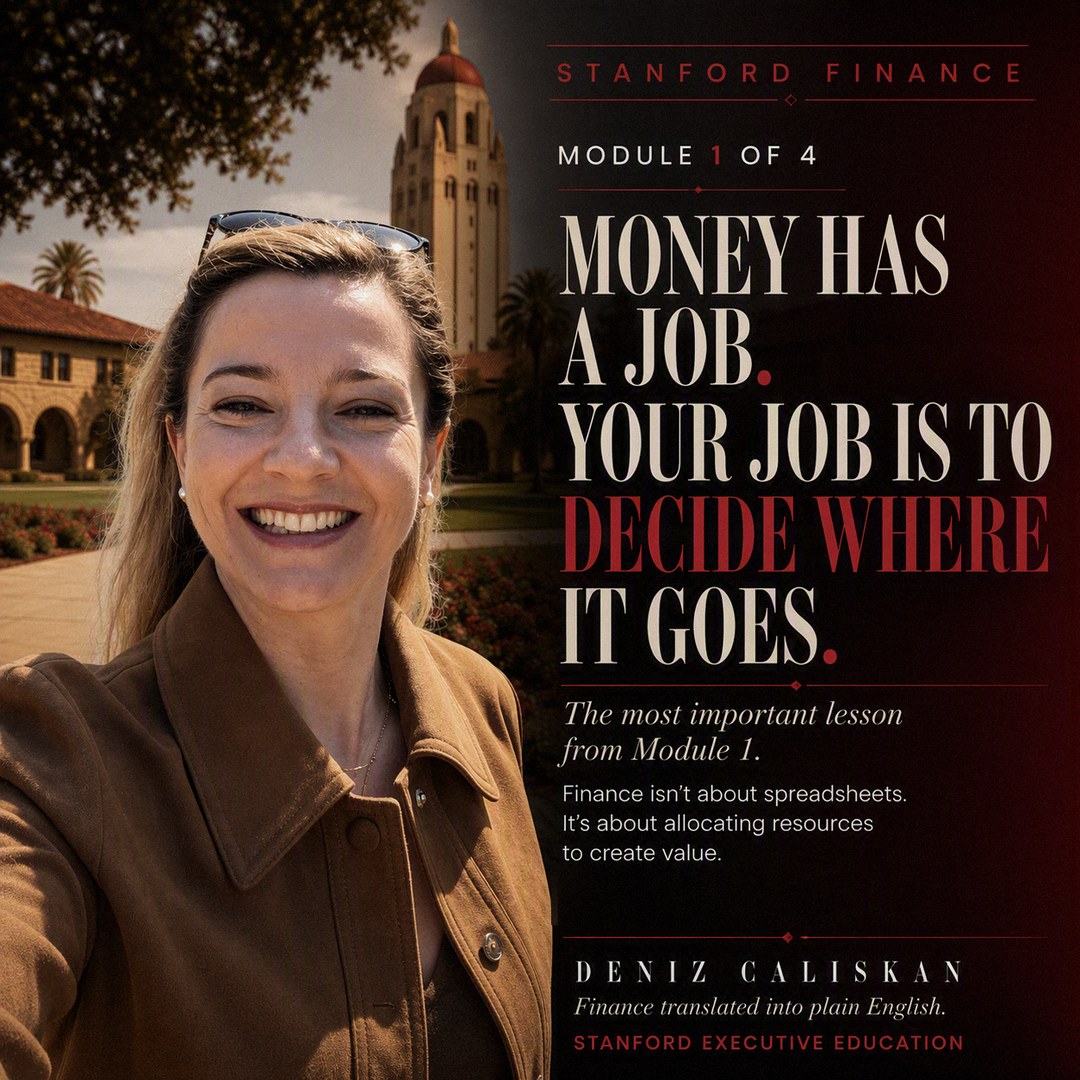
For most of my career, financial statements felt like a foreign language I was supposed to already speak. Rows of numbers, three different documents, and a quiet assumption in the room that everyone understood them but me.
Here's what changed it: someone finally told me that the three statements are just three ways of answering three different questions about a business.
- The income statement answers: did we make a profit over this period?
- The balance sheet answers: what do we own and owe, right now?
- The cash flow statement answers: did actual money come in or go out?
That's it. Three questions. Once I had that, the numbers stopped being maths and started being a story.
Profit and cash are not the same thing
This was the lesson that genuinely surprised me — and it's the one that catches out most non-finance people. A business can be profitable on paper and still run out of money. It can also burn cash for years while looking like a roaring success.
How? Because profit is an opinion shaped by timing and judgement — when you record a sale, how you spread a cost. Cash is a fact — the money is either in the account or it isn't. The old line I picked up: revenue is vanity, profit is sanity, cash is reality.
For anyone leading a team or a project, this reframe is powerful. The question isn't just "are we profitable?" It's "are we actually generating cash?" — because cash is what keeps the lights on.
You don't need to build them. You need to read them.
The liberating realisation: as a leader, your job isn't to prepare financial statements — that's what finance teams are for. Your job is to read them well enough to ask good questions. To spot when something looks off. To understand what the numbers are telling you about the health of what you're running.
That's a far smaller, far more achievable skill than "learn accounting." And it's the one that actually matters in the room.
What I took into practice
I stopped seeing finance as a wall and started seeing it as a story with three chapters. Now, when I look at any set of numbers, I ask the three questions — profit, position, cash — and suddenly I'm following the plot instead of drowning in the detail.
Next in the series: why a pound today is worth more than a pound tomorrow — and why that one idea underpins almost every financial decision.
Did anyone ever actually explain the difference between profit and cash to you — or were you also left to figure it out? I'd love to know I'm not alone.